SPECIFIC GROUPS


1 - 4
<
>
SYMPTOM CHECKER
CONDITIONS
Male
Female
Arm, Hand & Shoulder Concerns
Legs & Feet Concerns
Dental & Mouth Concerns
Ear & Nose
Eye Conditions
Head Conditions
Arm, Hand & Shoulder Concerns
Legs & Feet Concerns
Front
Back
Arm, Hand & Shoulder Concerns
Dental & Mouth Concerns
Ear & Nose
Eye Conditions
Head Conditions
Arm, Hand & Shoulder Concerns
Dental & Mouth Concerns
Ear & Nose
Eye Conditions
Head Conditions
Front
Back
Living
Healthy
Online Clinic
Wise Healthcare
Online Counseling Center
Family Life
Financial Wellness
Travel Safely Checklist

Print on Demand
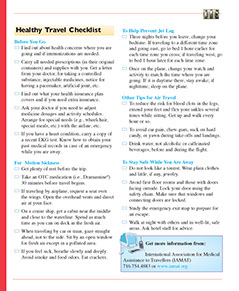
Before You Go
• Find out about health concerns where you are going and if immunizations are needed.
• Carry all needed prescriptions (in their original containers) and supplies with you. Get a letter from your doctor, for taking a controlled substance, injectable medicines, notice for having a pacemaker, artificial joint, etc.
• Find out what your health insurance plan covers and if you need extra insurance.
• Ask your doctor if you need to adjust medicine dosages and activity schedules. Arrange for special needs (e.g., wheelchair, special meals, etc.) with the airline, etc.
• If you have a heart condition, carry a copy of a recent EKG test. Know how to obtain your past medical records in case of an emergency while you are away.
For Motion Sickness
• Get plenty of rest before the trip.
• Take an OTC medication (i.e., Dramamine®) 30 minutes before travel begins.
• If traveling by airplane, request a seat over the wings. Open the overhead vents and direct air at your face.
• On a cruise ship, get a cabin near the middle and close to the waterline. Spend as much time as you can on deck in the fresh air.
• When traveling by car or train, gaze straight ahead, not to the side. Sit by an open window for fresh air except in a polluted area.
• If you feel sick, breathe slowly and deeply. Avoid smoke and food odors. Eat crackers.
To Help Prevent Jet Lag
Resources
• Three nights before you leave, change your bedtime. If traveling to a different time zone and going east, go to bed 1 hour earlier for each time zone you cross; if traveling west, go to bed 1 hour later for each time zone.
• Once on the plane, change your watch and activity to match the time where you are going. If it is daytime there, stay awake; if nighttime, sleep on the plane.
To Stay Safe While You Are Away
• Do not look like a tourist. Wear plain clothes and little, if any, jewelry.
• Avoid first floor rooms and those with doors facing outside. Lock your door using the safety chain. Make sure that windows and connecting doors are locked.
• Study the emergency exit map to prepare for an escape.
• Walk at night with others and in well-lit, safe areas. Ask hotel staff for advice.
Other Tips for Air Travel
• To reduce the risk for blood clots in the legs, extend your feet and flex your ankles several times while sitting. Get up and walk every hour or so.
• To avoid ear pain, chew gum, suck on hard candy, or yawn during take-offs and landings.
• Drink water, not alcoholic or caffeinated beverages, before and during the flight.
This website is not meant to substitute for expert medical advice or treatment. Follow your doctor’s or health care provider’s advice if it differs from what is given in this guide.
The American Institute for Preventive Medicine (AIPM) is not responsible for the availability or content of external sites, nor does AIPM endorse them. Also, it is the responsibility of the user to examine the copyright and licensing restrictions of external pages and to secure all necessary permission.
The content on this website is proprietary. You may not modify, copy, reproduce, republish, upload, post, transmit, or distribute, in any manner, the material on the website without the written permission of AIPM.
2022 © American Institute for Preventive Medicine - All Rights Reserved. Disclaimer | www.HealthyLife.com