


SPECIFIC GROUPS


1 - 4
<
>
SYMPTOM CHECKER
CONDITIONS
Male
Female
Arm, Hand & Shoulder Concerns
Legs & Feet Concerns
Dental & Mouth Concerns
Ear & Nose
Eye Conditions
Head Conditions
Arm, Hand & Shoulder Concerns
Legs & Feet Concerns
Front
Back
Arm, Hand & Shoulder Concerns
Dental & Mouth Concerns
Ear & Nose
Eye Conditions
Head Conditions
Arm, Hand & Shoulder Concerns
Dental & Mouth Concerns
Ear & Nose
Eye Conditions
Head Conditions
Front
Back
Living
Healthy
Online Clinic
Wise Healthcare
Online Counseling Center
Family Life
Financial Wellness
Lose Weight by Cleaning Up Psychological Pollution
Print on Demand

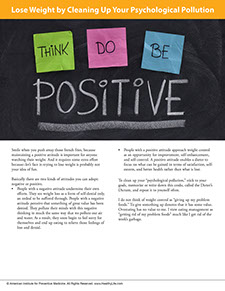
Smile when you push away those french fries, because maintaining a positive attitude is important for anyone watching their weight. And it requires some extra effort because–let’s face it–trying to lose weight is probably not your idea of fun.
Basically there are two kinds of attitudes you can adopt: negative or positive.
RELATED ARTICLES
• People with a negative attitude undermine their own efforts. They see weight loss as a form of self-denial only, an ordeal to be suffered through. People with a negative attitude perceive that something of great value has been denied. They pollute their minds with this negative thinking in much the same way that we pollute our air and water. As a result, they soon begin to feel sorry for themselves and end up eating to relieve those feelings of loss and denial.
• People with a positive attitude approach weight control as an opportunity for improvement, self-enhancement, and self-control. A positive attitude enables a dieter to focus on what can be gained in terms of satisfaction, self-esteem, and better health rather than what is lost.
To clean up your “psychological pollution,” stick to your goals, memorize or write down this credo, called the Dieter’s Dictum, and repeat it to yourself often.
I do not think of weight control as “giving up my problem foods.” To give something up denotes that it has some value. Overeating has no value to me. I view eating management as “getting rid of my problem foods” much like I get rid of the week’s garbage.
This website is not meant to substitute for expert medical advice or treatment. Follow your doctor’s or health care provider’s advice if it differs from what is given in this guide.
The American Institute for Preventive Medicine (AIPM) is not responsible for the availability or content of external sites, nor does AIPM endorse them. Also, it is the responsibility of the user to examine the copyright and licensing restrictions of external pages and to secure all necessary permission.
The content on this website is proprietary. You may not modify, copy, reproduce, republish, upload, post, transmit, or distribute, in any manner, the material on the website without the written permission of AIPM.
2022 © American Institute for Preventive Medicine - All Rights Reserved. Disclaimer | www.HealthyLife.com


