


SPECIFIC GROUPS


1 - 4
<
>
SYMPTOM CHECKER
CONDITIONS
Male
Female
Arm, Hand & Shoulder Concerns
Legs & Feet Concerns
Dental & Mouth Concerns
Ear & Nose
Eye Conditions
Head Conditions
Arm, Hand & Shoulder Concerns
Legs & Feet Concerns
Front
Back
Arm, Hand & Shoulder Concerns
Dental & Mouth Concerns
Ear & Nose
Eye Conditions
Head Conditions
Arm, Hand & Shoulder Concerns
Dental & Mouth Concerns
Ear & Nose
Eye Conditions
Head Conditions
Front
Back
Living
Healthy
Online Clinic
Wise Healthcare
Online Counseling Center
Family Life
Financial Wellness
Fitness in Flight
Print on Demand
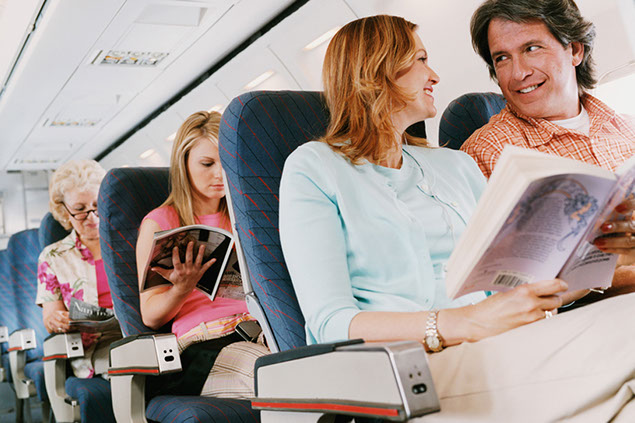
Sitting in a narrow, crowded airplane seat for hours causes cramped and achy muscles, swollen feet, and fatigue. And anyone who has a problem with circulation in his or her legs runs a risk of thrombophlebitis when sitting for long periods of time. Fortunately, there are ways to prevent the typical aches and pains travelers frequently experience during long flights. One is to charter your own plane and stretch out in comfort. If you’re like most people, however, a private plane is probably beyond your means. Instead, you can try to reduce stiffness with the following exercises.
RELATED ARTICLES
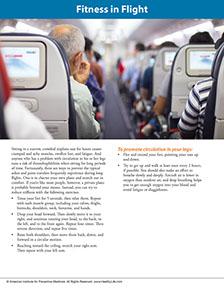
• Tense your feet for 5 seconds, then relax them. Repeat with each muscle group, including your calves, thighs, buttocks, shoulders, neck, forearms, and hands.
• Drop your head forward. Then slowly move it to your right, and continue rotating your head, to the back, to the left, and to the front again. Repeat four times. Then reverse direction, and repeat five times.
• Raise both shoulders, then move them back, down, and forward in a circular motion.
• Reaching toward the ceiling, stretch your right arm. Then repeat with your left arm.
To promote circulation in your legs:
• Flex and extend your feet, pointing your toes up and down.
• Try to get up and walk at least once every 2 hours, if possible. You should also make an effort to breathe slowly and deeply. Aircraft air is lower in oxygen than outdoor air, and deep breathing helps you to get enough oxygen into your blood and avoid fatigue or sluggishness.
This website is not meant to substitute for expert medical advice or treatment. Follow your doctor’s or health care provider’s advice if it differs from what is given in this guide.
The American Institute for Preventive Medicine (AIPM) is not responsible for the availability or content of external sites, nor does AIPM endorse them. Also, it is the responsibility of the user to examine the copyright and licensing restrictions of external pages and to secure all necessary permission.
The content on this website is proprietary. You may not modify, copy, reproduce, republish, upload, post, transmit, or distribute, in any manner, the material on the website without the written permission of AIPM.
2022 © American Institute for Preventive Medicine - All Rights Reserved. Disclaimer | www.HealthyLife.com


