


SPECIFIC GROUPS


1 - 4
<
>
SYMPTOM CHECKER
CONDITIONS
Male
Female
Arm, Hand & Shoulder Concerns
Legs & Feet Concerns
Dental & Mouth Concerns
Ear & Nose
Eye Conditions
Head Conditions
Arm, Hand & Shoulder Concerns
Legs & Feet Concerns
Front
Back
Arm, Hand & Shoulder Concerns
Dental & Mouth Concerns
Ear & Nose
Eye Conditions
Head Conditions
Arm, Hand & Shoulder Concerns
Dental & Mouth Concerns
Ear & Nose
Eye Conditions
Head Conditions
Front
Back
Living
Healthy
Online Clinic
Wise Healthcare
Online Counseling Center
Family Life
Financial Wellness
Control Your Cholesterol & Triglycerides
Print on Demand
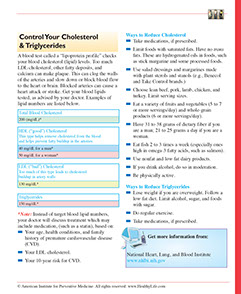
A blood test called a “lipoprotein profile” checks your blood cholesterol (lipid) levels. Too much LDL-cholesterol, other fatty deposits, and calcium can make plaque. This can clog the walls of the arteries and slow down or block blood flow to the heart or brain. Blocked arteries can cause a heart attack or stroke. Get your blood lipids tested, as advised by your doctor. Examples of lipid numbers are listed below.
RELATED ARTICLES
*Note: Instead of target blood lipid numbers, your doctor will discuss treatment which may include medication, (such as a statin), based on:
• Your age, health conditions, and family history of premature cardiovascular disease (CVD).
• Your LDL-cholesterol.
• Your 10-year risk for CVD.
Ways to Reduce Cholesterol
• Take medications, if prescribed.
• Limit foods with saturated fats. Have no trans fats. These are hydrogenated oils in foods, such as stick margarine and some processed foods.
• Use salad dressings and margarines made with plant sterols and stanols (e.g., Benecol and Take Control brands.)
• Choose lean beef, pork, lamb, chicken, and turkey. Limit serving sizes.
• Eat a variety of fruits and vegetables (5 to 7 or more servings/day) and whole-grain products (6 or more servings/day).
• Have 31 to 38 grams of dietary fiber if you are a man; 21 to 25 grams a day if you are a woman.
• Eat fish 2 to 3 times a week (especially ones high in omega-3 fatty acids, such as salmon).
• Use nonfat and low-fat dairy products.
• If you drink alcohol, do so in moderation.
• Be physically active.
Ways to Reduce Triglycerides
• Lose weight if you are overweight. Follow a low-fat diet. Limit alcohol, sugar, and foods with sugar.
• Get regular exercise.
• Take medications, if prescribed.
This website is not meant to substitute for expert medical advice or treatment. Follow your doctor’s or health care provider’s advice if it differs from what is given in this guide.
The American Institute for Preventive Medicine (AIPM) is not responsible for the availability or content of external sites, nor does AIPM endorse them. Also, it is the responsibility of the user to examine the copyright and licensing restrictions of external pages and to secure all necessary permission.
The content on this website is proprietary. You may not modify, copy, reproduce, republish, upload, post, transmit, or distribute, in any manner, the material on the website without the written permission of AIPM.
2022 © American Institute for Preventive Medicine - All Rights Reserved. Disclaimer | www.HealthyLife.com


