

SPECIFIC GROUPS




1 - 4
<
>
SYMPTOM CHECKER
CONDITIONS
Male
Female
Arm, Hand & Shoulder Concerns
Legs & Feet Concerns
Dental & Mouth Concerns
Ear & Nose
Eye Conditions
Head Conditions
Arm, Hand & Shoulder Concerns
Legs & Feet Concerns
Front
Back
Arm, Hand & Shoulder Concerns
Dental & Mouth Concerns
Ear & Nose
Eye Conditions
Head Conditions
Arm, Hand & Shoulder Concerns
Dental & Mouth Concerns
Ear & Nose
Eye Conditions
Head Conditions
Front
Back
Living
Healthy
Online Clinic
Wise Healthcare
Online Counseling Center
Family Life
Financial Wellness
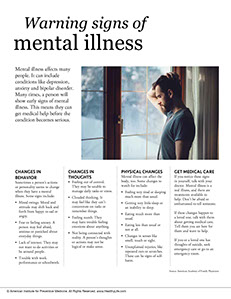
Warning signs of mental illness
Print on Demand

Mental illness affects many people. It can include conditions like depression, anxiety and bipolar disorder. Many times, a person will show early signs of mental illness. This means they can get medical help before the condition becomes serious.
Changes in behavior
Sometimes a person’s actions or personality seems to change when they have a mental illness. Some signs include:
• Mood swings. Mood and attitude may shift back and forth from happy to sad or angry.
• Fear or feeling uneasy. A person may feel afraid, anxious or panicked about everyday things.
• Lack of interest. They may not want to do activities or be around people.
• Trouble with work performance or schoolwork.
Changes in thoughts
• Feeling out of control. They may be unable to manage daily tasks or stress.
• Clouded thinking. It may feel like they can’t concentrate on tasks or remember things.
• Feeling numb. They may have trouble feeling emotions about anything.
• Not being connected with reality. A person’s thoughts or actions may not be logical or make sense.
Physical changes
Mental illness can affect the body, too. Some changes to watch for include:
• Feeling very tired or sleeping much more than usual.
• Getting very little sleep or an inability to sleep.
• Eating much more than usual.
• Eating less than usual or not at all.
• Changes in senses like smell, touch or sight.
• Unexplained injuries, like repeated cuts or scratches. These can be signs of self-harm.
Get medical care
If you notice these signs in yourself, talk with your doctor. Mental illness is a real illness, and there are treatments available to help. Don’t be afraid or embarrassed to tell someone.
If these changes happen to a loved one, talk with them about getting medical care. Tell them you are here for them and want to help.
If you or a loved one has thoughts of suicide, seek emergency care or go to an emergency room.
Source: American Academy of Family Physicians
This website is not meant to substitute for expert medical advice or treatment. Follow your doctor’s or health care provider’s advice if it differs from what is given in this guide.
The American Institute for Preventive Medicine (AIPM) is not responsible for the availability or content of external sites, nor does AIPM endorse them. Also, it is the responsibility of the user to examine the copyright and licensing restrictions of external pages and to secure all necessary permission.
The content on this website is proprietary. You may not modify, copy, reproduce, republish, upload, post, transmit, or distribute, in any manner, the material on the website without the written permission of AIPM.
2022 © American Institute for Preventive Medicine - All Rights Reserved. Disclaimer | www.HealthyLife.com