
SPECIFIC GROUPS




1 - 4
<
>
SYMPTOM CHECKER
CONDITIONS
Male
Female
Arm, Hand & Shoulder Concerns
Legs & Feet Concerns
Dental & Mouth Concerns
Ear & Nose
Eye Conditions
Head Conditions
Arm, Hand & Shoulder Concerns
Legs & Feet Concerns
Front
Back
Arm, Hand & Shoulder Concerns
Dental & Mouth Concerns
Ear & Nose
Eye Conditions
Head Conditions
Arm, Hand & Shoulder Concerns
Dental & Mouth Concerns
Ear & Nose
Eye Conditions
Head Conditions
Front
Back
Living
Healthy
Online Clinic
Wise Healthcare
Online Counseling Center
Family Life
Financial Wellness
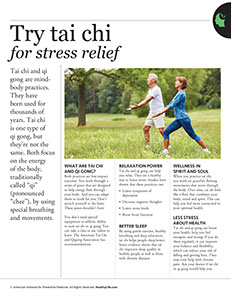
Try tai chi for stress relief

Print on Demand
Tai chi and qi gong are mind-body practices. They have been used for thousands of years. Tai chi is one type of qi gong, but they’re not the same. Both focus on the energy of the body, traditionally called “qi” (pronounced “chee”), by using special breathing and movements.
What are tai chi and qi gong?
Both practices are low-impact exercises. You work through a series of poses that are designed to help energy flow through your body. And you can adapt them to work for you. Don’t stretch yourself to the limit. These poses shouldn’t hurt.
You don’t need special equipment or athletic ability to start tai chi or qi gong. You can take a class or use videos to learn. The American Tai Chi and Qigong Association has recommendations.
Relaxation power
Tai chi and qi gong can help you relax. They are a healthy way to lower stress. Studies have shown that these practices can:
• Lower symptoms of depression
• Decrease negative thoughts
• Lower stress levels
• Boost brain function
Better sleep
By using gentle exercise, healthy breathing and deep relaxation, tai chi helps people sleep better. Some evidence shows that tai chi improves sleep quality in healthy people as well as those with chronic diseases.
Wellness in spirit and soul
When you practice tai chi, you work on graceful, flowing movements that move through the body. Over time, tai chi feels like a flow that combines your body, mind and spirit. This can help you feel more connected to your spiritual health.
Less stress about health
Tai chi and qi gong can boost your health, help you feel energetic and strong. If you do them regularly, it can improve your balance and flexibility, which can reduce your risk of falling and getting hurt. They may even help with chronic pain. Ask your doctor if tai chi or qi gong would help you.
This website is not meant to substitute for expert medical advice or treatment. Follow your doctor’s or health care provider’s advice if it differs from what is given in this guide.
The American Institute for Preventive Medicine (AIPM) is not responsible for the availability or content of external sites, nor does AIPM endorse them. Also, it is the responsibility of the user to examine the copyright and licensing restrictions of external pages and to secure all necessary permission.
The content on this website is proprietary. You may not modify, copy, reproduce, republish, upload, post, transmit, or distribute, in any manner, the material on the website without the written permission of AIPM.
2022 © American Institute for Preventive Medicine - All Rights Reserved. Disclaimer | www.HealthyLife.com