

SPECIFIC GROUPS




1 - 4
<
>
SYMPTOM CHECKER
CONDITIONS
Male
Female
Arm, Hand & Shoulder Concerns
Legs & Feet Concerns
Dental & Mouth Concerns
Ear & Nose
Eye Conditions
Head Conditions
Arm, Hand & Shoulder Concerns
Legs & Feet Concerns
Front
Back
Arm, Hand & Shoulder Concerns
Dental & Mouth Concerns
Ear & Nose
Eye Conditions
Head Conditions
Arm, Hand & Shoulder Concerns
Dental & Mouth Concerns
Ear & Nose
Eye Conditions
Head Conditions
Front
Back
Living
Healthy
Online Clinic
Wise Healthcare
Online Counseling Center
Family Life
Financial Wellness
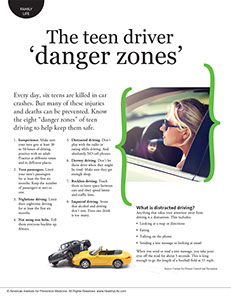
The teen driver ‘danger zones’
Print on Demand

Every day, six teens are killed in car crashes. But many of these injuries and deaths can be prevented. Know the eight “danger zones” of teen driving to help keep them safe.
1. Inexperience. Make sure your teen gets at least 30 to 50 hours of driving practice with an adult. Practice at different times and in different places.
2. Teen passengers. Limit your teen’s passengers for at least the first six months. Keep the number of passengers at zero or one.
3. Nighttime driving. Limit their nighttime driving for at least the first six months.
4. Not using seat belts. Tell them everyone buckles up. Always.
5. Distracted driving. Don’t play with the radio or eating while driving. And absolutely NO cell phones.
6. Drowsy driving. Don’t let them drive when they might be tired. Make sure they get enough sleep.
7. Reckless driving. Teach them to leave space between cars and obey speed limits and traffic laws.
8. Impaired driving. Stress that alcohol and driving don’t mix. Even one drink is too many.
What is distracted driving?
Anything that takes your attention away from driving is a distraction. This includes:
• Looking at a map or directions
• Eating
• Talking on the phone
• Sending a text message or looking at email
When you send or read a text message, you take your eyes off the road for about 5 seconds. This is long enough to go the length of a football field at 55 mph.
Source: Centers for Disease Control and Prevention
This website is not meant to substitute for expert medical advice or treatment. Follow your doctor’s or health care provider’s advice if it differs from what is given in this guide.
The American Institute for Preventive Medicine (AIPM) is not responsible for the availability or content of external sites, nor does AIPM endorse them. Also, it is the responsibility of the user to examine the copyright and licensing restrictions of external pages and to secure all necessary permission.
The content on this website is proprietary. You may not modify, copy, reproduce, republish, upload, post, transmit, or distribute, in any manner, the material on the website without the written permission of AIPM.
2022 © American Institute for Preventive Medicine - All Rights Reserved. Disclaimer | www.HealthyLife.com