

SPECIFIC GROUPS




1 - 4
<
>
SYMPTOM CHECKER
CONDITIONS
Male
Female
Arm, Hand & Shoulder Concerns
Legs & Feet Concerns
Dental & Mouth Concerns
Ear & Nose
Eye Conditions
Head Conditions
Arm, Hand & Shoulder Concerns
Legs & Feet Concerns
Front
Back
Arm, Hand & Shoulder Concerns
Dental & Mouth Concerns
Ear & Nose
Eye Conditions
Head Conditions
Arm, Hand & Shoulder Concerns
Dental & Mouth Concerns
Ear & Nose
Eye Conditions
Head Conditions
Front
Back
Living
Healthy
Online Clinic
Wise Healthcare
Online Counseling Center
Family Life
Financial Wellness
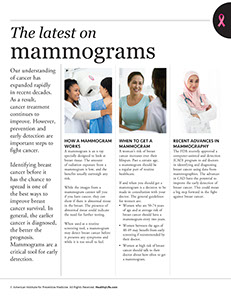
The latest on mammograms

Print on Demand
Our understanding of cancer has expanded rapidly in recent decades. As a result, cancer treatment continues to improve. However, prevention and early detection are important steps to fight cancer.
Identifying breast cancer before it has the chance to spread is one of the best ways to improve breast cancer survival. In general, the earlier cancer is diagnosed, the better the prognosis. Mammograms are a critical tool for early detection.
How a mammogram works
A mammogram is an x-ray specially designed to look at breast tissue. The amount of radiation exposure from a mammogram is low, and the benefits usually outweigh any risk.
While the images from a mammogram cannot tell you if you have cancer, they can show if there is abnormal tissue in the breast. The presence of abnormal tissue could indicate the need for further testing.
When used as a routine screening tool, a mammogram may detect breast cancer before it presents any symptoms and while it is too small to feel.
When to get a mammogram
A woman’s risk of breast cancer increases over their lifespan. Past a certain age, a mammogram should be a regular part of routine healthcare.
If and when you should get a mammogram is a decision to be made in consultation with your doctor. The general guidelines for women are:
• Women who are 50-74 years of age and at average risk of breast cancer should have a mammogram every two years.
• Women between the ages of 40-49 may benefit from early screening if recommended by their doctor.
• Women at high risk of breast cancer should talk to their doctor about how often to get a mammogram.
Recent Advances in Mammography
The FDA recently approved a computer-assisted and detection (CAD) program to aid doctors in identifying and diagnosing breast cancer using data from mammographies. The advances in CAD have the potential to improve the early detection of breast cancer. This could mean a big step forward in the fight against breast cancer.
This website is not meant to substitute for expert medical advice or treatment. Follow your doctor’s or health care provider’s advice if it differs from what is given in this guide.
The American Institute for Preventive Medicine (AIPM) is not responsible for the availability or content of external sites, nor does AIPM endorse them. Also, it is the responsibility of the user to examine the copyright and licensing restrictions of external pages and to secure all necessary permission.
The content on this website is proprietary. You may not modify, copy, reproduce, republish, upload, post, transmit, or distribute, in any manner, the material on the website without the written permission of AIPM.
2022 © American Institute for Preventive Medicine - All Rights Reserved. Disclaimer | www.HealthyLife.com