

SPECIFIC GROUPS




1 - 4
<
>
SYMPTOM CHECKER
CONDITIONS
Male
Female
Arm, Hand & Shoulder Concerns
Legs & Feet Concerns
Dental & Mouth Concerns
Ear & Nose
Eye Conditions
Head Conditions
Arm, Hand & Shoulder Concerns
Legs & Feet Concerns
Front
Back
Arm, Hand & Shoulder Concerns
Dental & Mouth Concerns
Ear & Nose
Eye Conditions
Head Conditions
Arm, Hand & Shoulder Concerns
Dental & Mouth Concerns
Ear & Nose
Eye Conditions
Head Conditions
Front
Back
Living
Healthy
Online Clinic
Wise Healthcare
Online Counseling Center
Family Life
Financial Wellness
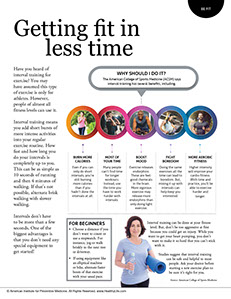
Getting fit in less time

Print on Demand
Have you heard of interval training for exercise? You may have assumed this type of exercise is only for athletes. However, people of almost all fitness levels can use it.
Interval training means you add short bursts of more intense activities into your regular exercise routine. How fast and how long you do your intervals is completely up to you. This can be as simple as 10 seconds of running and then 4 minutes of walking. If that’s not possible, alternate brisk walking with slower walking.
Intervals don’t have to be more than a few seconds. One of the biggest advantages is that you don’t need any special equipment to get started!
Why should I do it?
The American College of Sports Medicine (ACSM) says interval training has several benefits, including:
• Burn more calories: Even if you can only do short intervals, you’re still burning more calories than if you hadn’t done the intervals at all.
• Most of your time: Many people can’t find time for longer workouts. Instead, use the time you have to work harder with intervals.
• Boost mood: Exercise releases endorphins. These are feel-good chemicals in the brain. More vigorous exercise may release more endorphins than only doing light exercise.
• Fight boredom: Doing the same exercises all the time can lead to boredom. But, mixing it up with intervals can help keep you interested.
• More aerobic fitness: Higher intensity will improve your cardio fitness. With time and practice, you’ll be able to exercise harder and longer.
For beginners
• Choose a distance if you don’t want to count or use a stopwatch. For instance, jog or walk briskly to the next tree or driveway.
• If using equipment like an elliptical machine or bike, alternate faster bouts of that exercise with your usual pace.
Interval training can be done at your fitness level. But, don’t be too aggressive at first because you could get an injury. While you want to get your heart pumping, you don’t want to make it so hard that you can’t stick with it.
Studies suggest that interval training can be safe and helpful to most people. Ask your doctor before starting a new exercise plan to be sure it’s right for you.
Source: American College of Sports Medicine
This website is not meant to substitute for expert medical advice or treatment. Follow your doctor’s or health care provider’s advice if it differs from what is given in this guide.
The American Institute for Preventive Medicine (AIPM) is not responsible for the availability or content of external sites, nor does AIPM endorse them. Also, it is the responsibility of the user to examine the copyright and licensing restrictions of external pages and to secure all necessary permission.
The content on this website is proprietary. You may not modify, copy, reproduce, republish, upload, post, transmit, or distribute, in any manner, the material on the website without the written permission of AIPM.
2022 © American Institute for Preventive Medicine - All Rights Reserved. Disclaimer | www.HealthyLife.com