
SPECIFIC GROUPS




1 - 4
<
>
SYMPTOM CHECKER
CONDITIONS
Male
Female
Arm, Hand & Shoulder Concerns
Legs & Feet Concerns
Dental & Mouth Concerns
Ear & Nose
Eye Conditions
Head Conditions
Arm, Hand & Shoulder Concerns
Legs & Feet Concerns
Front
Back
Arm, Hand & Shoulder Concerns
Dental & Mouth Concerns
Ear & Nose
Eye Conditions
Head Conditions
Arm, Hand & Shoulder Concerns
Dental & Mouth Concerns
Ear & Nose
Eye Conditions
Head Conditions
Front
Back
Living
Healthy
Online Clinic
Wise Healthcare
Online Counseling Center
Family Life
Financial Wellness
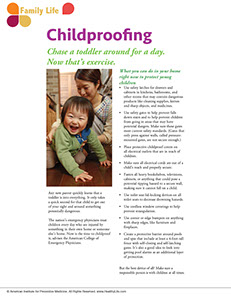
Childproofing

Print on Demand
Chase a toddler around for a day. Now that’s exercise. Any new parent quickly learns that a toddler is into everything. It only takes a quick second for that child to get out of your sight and around something potentially dangerous.
The nation’s emergency physicians treat children every day who are injured by something in their own home or someone else’s home. Now is the time to childproof it, advises the American College of Emergency Physicians.
What you can do in your home right now to protect young children
• Use safety latches for drawers and cabinets in kitchens, bathrooms, and other rooms that may contain dangerous products like cleaning supplies, knives and sharp objects, and medicines.
• Use safety gates to help prevent falls down stairs and to help prevent children from going in areas that may have potential dangers. Make sure these gates meet current safety standards. (Gates that only press against walls, called pressure-mounted gates, are not secure enough.)
• Place protective childproof covers on all electrical outlets that are in reach of children.
• Make sure all electrical cords are out of a child’s reach and properly secure.
• Fasten all heavy bookshelves, televisions, cabinets, or anything that could pose a potential tipping hazard to a secure wall, making sure it cannot fall on a child.
• Use toilet seat lid-locking devices on all toilet seats to decrease drowning hazards.
• Use cordless window coverings to help prevent strangulation.
• Use corner or edge bumpers on anything with sharp edges, like furniture and fireplaces.
• Create a protective barrier around pools and spas that include at least a 4-foot-tall fence with self-closing and self-latching gates. It’s also a good idea to look into getting pool alarms as an additional layer of protection.
But the best device of all? Make sure a responsible person is with children at all times.
This website is not meant to substitute for expert medical advice or treatment. Follow your doctor’s or health care provider’s advice if it differs from what is given in this guide.
The American Institute for Preventive Medicine (AIPM) is not responsible for the availability or content of external sites, nor does AIPM endorse them. Also, it is the responsibility of the user to examine the copyright and licensing restrictions of external pages and to secure all necessary permission.
The content on this website is proprietary. You may not modify, copy, reproduce, republish, upload, post, transmit, or distribute, in any manner, the material on the website without the written permission of AIPM.
2022 © American Institute for Preventive Medicine - All Rights Reserved. Disclaimer | www.HealthyLife.com