
SPECIFIC GROUPS



1 - 4
<
>
SYMPTOM CHECKER
CONDITIONS
Male
Female
Arm, Hand & Shoulder Concerns
Legs & Feet Concerns
Dental & Mouth Concerns
Ear & Nose
Eye Conditions
Head Conditions
Arm, Hand & Shoulder Concerns
Legs & Feet Concerns
Front
Back
Arm, Hand & Shoulder Concerns
Dental & Mouth Concerns
Ear & Nose
Eye Conditions
Head Conditions
Arm, Hand & Shoulder Concerns
Dental & Mouth Concerns
Ear & Nose
Eye Conditions
Head Conditions
Front
Back
Living
Healthy
Online Clinic
Wise Healthcare
Online Counseling Center
Family Life
Financial Wellness
Part 2: Choose Your Fuel
How Much Energy Do I Need?
Print on Demand

Calories are units of energy that fuel your body for daily functions like breathing, eating, and thinking. Calories are also burned during physical activity. The more active you are, the more energy your body needs. Use the chart below to find your estimated daily energy needs. Calories needed vary by sex, age, and activity level. To determine your activity level, consider how you spend most of your day.
• Sedentary: You sit most of the day and do little to no physical activity (e.g., you walk once a week or do light gardening).
• Moderately Active: Your work involves movement, such as cleaning or light industrial work. You do some moderate-intensity physical activity a few times a week, like brisk walking or cycling.
• Active: Your work involves a lot of movement, such as heavy industrial work, construction work, or farming. You do physical activity most days during the week, such as jogging, swimming laps, intense walking, weight lifting, or sports.
HealthyLife® Weigh
QUICK LINKS: PART 2
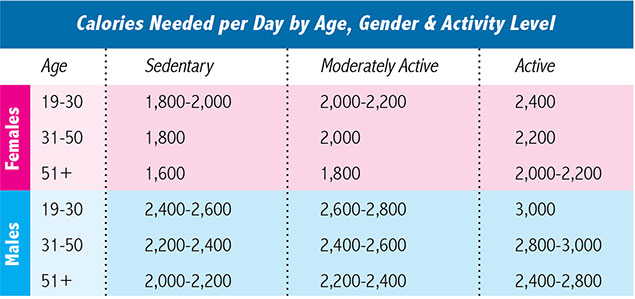
These are roughly the calories you need per day to stay at your current weight.
To lose 1 pound per week, you need to take in 500 fewer calories than you use/burn through daily activity. This guide encourages gradual, long-lasting weight loss.
You can get your specific daily energy needs using the USDA’s SuperTracker online tool. Find this at www.choosemyplate.gov/resources/MyPlatePlan.
You can lose weight without severely restricting calories. Eating fewer than 1,200 calories per day can make it difficult for you to get all the nutrients you need. Eating this way can also be hard to follow long-term. A diet with fewer than 1,200 calories should be supervised by a doctor or dietitian.
Special nutrition needs
Talk to your doctor or dietitian before choosing an eating plan if you have special nutrition needs, such as:
• You are pregnant or breastfeeding
• You have a health condition or take medications
This website is not meant to substitute for expert medical advice or treatment. Follow your doctor’s or health care provider’s advice if it differs from what is given in this guide.
The American Institute for Preventive Medicine (AIPM) is not responsible for the availability or content of external sites, nor does AIPM endorse them. Also, it is the responsibility of the user to examine the copyright and licensing restrictions of external pages and to secure all necessary permission.
The content on this website is proprietary. You may not modify, copy, reproduce, republish, upload, post, transmit, or distribute, in any manner, the material on the website without the written permission of AIPM.
2022 © American Institute for Preventive Medicine - All Rights Reserved. Disclaimer | www.HealthyLife.com