SPECIFIC GROUPS


1 - 4
<
>
CONDITIONS
SYMPTOM CHECKER
Male
Female
Arm, Hand & Shoulder Concerns
Broken Bones
Legs & Feet Concerns
Dental & Mouth Concerns
Ear & Nose
Eye Conditions
Head Conditions
Arm, Hand & Shoulder Concerns
Broken Bones
Legs & Feet Concerns
Front
Back
Arm, Hand & Shoulder Concerns
Broken Bones
Dental & Mouth Concerns
Ear & Nose
Eye Conditions
Head Conditions
Arm, Hand & Shoulder Concerns
Broken Bones
Dental & Mouth Concerns
Ear & Nose
Eye Conditions
Head Conditions
Front
Back
Living
Healthy
Online Clinic
Wise Healthcare
Mental & Social Health
Family Life
Financial Wellness
Handle Food with Care
Print on Demand
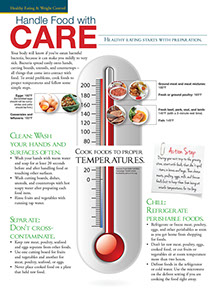
Healthy eating starts with preparation.
Your body will know if you’ve eaten harmful bacteria, because it can make you mildly to very sick. Bacteria spread easily onto hands, cutting boards, utensils, and countertops – all things that come into contact with food. To avoid problems, cook foods to proper temperatures and follow some simple steps.
RELATED ARTICLES
Clean: Wash your hands and surfaces often.
• Wash your hands with warm water and soap for at least 20 seconds before and after handling food or touching other surfaces.
• Wash cutting boards, dishes, utensils, and countertops with hot soapy water after preparing each food item.
• Rinse fruits and vegetables with running tap water.
Separate: Don’t cross-contaminate.
• Keep raw meat, poultry, seafood and eggs separate from other foods.
• Use one cutting board for fruits and vegetables and another for meat, poultry, seafood, or eggs.
• Never place cooked food on a plate that held raw food.
Chill: Refrigerate perishable foods.
• Refrigerate or freeze meat, poultry, eggs, and other perishables as soon as you get home from shopping for foods.
• Don’t let raw meat, poultry, eggs, cooked food, or cut fruits or vegetables sit at room temperature more than two hours.
• Defrost foods in the refrigerator or cold water. Use the microwave on the defrost setting if you are cooking the food right away.
Cook foods to proper temperatures.
Eggs: 160ºF (Scrambled eggs should not be runny; whites and yolks should be firm.)
Casseroles and leftovers: 165ºF
Ground meat and meat mixtures: 160ºF
Fresh or ground poultry: 165ºF
Fresh beef, pork, veal, and lamb: 145ºF (with a 3-minute rest time)
Fish: 145ºF
Action Step
During your next trip to the grocery store, start with foods that don’t spoil − items in boxes and bags. Then choose meats, poultry, eggs, milk, and frozen foods last to keep them from being at unsafe temperatures for too long.
This website is not meant to substitute for expert medical advice or treatment. Follow your doctor’s or health care provider’s advice if it differs from what is given in this guide.
The American Institute for Preventive Medicine (AIPM) is not responsible for the availability or content of external sites, nor does AIPM endorse them. Also, it is the responsibility of the user to examine the copyright and licensing restrictions of external pages and to secure all necessary permission.
The content on this website is proprietary. You may not modify, copy, reproduce, republish, upload, post, transmit, or distribute, in any manner, the material on the website without the written permission of AIPM.
Pediatric Care
2022 © American Institute for Preventive Medicine - All Rights Reserved. Disclaimer | www.HealthyLife.com