


SPECIFIC GROUPS


1 - 4
<
>
CONDITIONS
SYMPTOM CHECKER
Male
Female
Arm, Hand & Shoulder Concerns
Broken Bones
Legs & Feet Concerns
Dental & Mouth Concerns
Ear & Nose
Eye Conditions
Head Conditions
Arm, Hand & Shoulder Concerns
Broken Bones
Legs & Feet Concerns
Front
Back
Arm, Hand & Shoulder Concerns
Broken Bones
Dental & Mouth Concerns
Ear & Nose
Eye Conditions
Head Conditions
Arm, Hand & Shoulder Concerns
Broken Bones
Dental & Mouth Concerns
Ear & Nose
Eye Conditions
Head Conditions
Front
Back
Living
Healthy
Online Clinic
Wise Healthcare
Mental & Social Health
Family Life
Financial Wellness
Burnout
Print on Demand

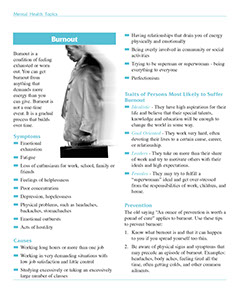
Burnout is a condition of feeling exhausted or worn out. You can get burnout from anything that demands more energy than you can give. Burnout is not a one-time event. It is a gradual process that builds over time.
Obsessive-Compulsive Behavior
• Emotional exhaustion
• Fatigue
• Loss of enthusiasm for work, school, family or friends
• Feelings of helplessness
• Poor concentration
• Depression, hopelessness
• Physical problems, such as headaches, backaches, stomachaches
• Emotional outbursts
• Acts of hostility
• Working long hours or more than one job
• Working in very demanding situations with low job satisfaction and little control
• Studying excessively or taking an excessively large number of classes
• Having relationships that drain you of energy physically and emotionally
• Being overly involved in community or social activities
• Trying to be superman or superwoman - being everything to everyone
• Perfectionism
Traits of Persons Most Likely to Suffer Burnout
• Idealistic - They have high aspirations for their life and believe that their special talents, knowledge and education will be enough to change the world in some way.
• Goal Oriented - They work very hard, often devoting their lives to a certain cause, career, or relationship.
• Leaders - They take on more than their share of work and try to motivate others with their ideals and high expectations.
• Females - They may try to fulfill a “superwoman” ideal and get over-stressed from the responsibilities of work, children, and home.
Prevention
The old saying “An ounce of prevention is worth a pound of cure” applies to burnout. Use these tips to prevent burnout:
1. Know what burnout is and that it can happen to you if you spread yourself too thin.
2. Be aware of physical signs and symptoms that may precede an episode of burnout. Examples: headaches, body aches, feeling tired all the time, often getting colds, and other common ailments.
3. Reduce long work or study hours if possible. The more you work and the less rest you get, the more likely you are to burn out. Prioritize your work load.
4. Take regular 5-10 minute relaxation breaks. Work or study done after a break can be more efficient.
5. Mentally remove yourself from your job, school, or other high stress situations. Step back and take a look from an outsider’s point of view. Imagine how others might handle your tasks.
6. Schedule a vacation at least once a year when you can take time to relax and do the things that you enjoy. Also, take daily breaks from your work or study for lunch outside of work, a walk, a crossword puzzle, etc.
7. Discuss with your supervisor any on-the-job problems that could be leading to burnout.
8. Get enough sleep and exercise.
9. Attempt to do well, but don’t try to be perfect.
Questions to Ask
Question 1
Do you suffer from more physical illnesses lately, such as headaches, colds, body aches and pains, stomach and other intestinal problems?
You should be seen by your doctor for medical advice. Contact your doctor or health care provider to find out how soon you should be seen.
Question 2
During the past six months, have you had any of these symptoms?
• Felt tired and worn out most of the time
• Been unable to carry out your normal daily activities
• Felt depressed a good deal of the time
• Enjoyed life less and less
You should be seen by your doctor or counselor. Contact your doctor, counselor or health care provider to find out how soon you should be seen.
Question 3
Do you have any of the following problems?
• You seem to be working harder and harder with no real accomplishment or satisfaction.
• You forget appointments and deadlines easily.
• You feel disoriented at the end of your workday.
See your mental health counselor, if you have one. If not, call your doctor for a referral. You will get advice on what to do.
Question 4
Do you have any of these problems?
• Increased frustration or anger on the job or in class
• A short temper
• Disappointment in others lately
• Increased difficulty in relating to others at work, school, home, and elsewhere
• You have begun to isolate yourself from others.
See your mental health counselor, if you have one. If not, call your doctor for a referral. You will get advice on what to do.
Use Self-Care / Prevention:
You can probably take care of the problem yourself if you answered NO to all the questions. Use the “Self-Care” measures that are listed. Call your doctor if you don’t feel better soon, though. You may have some other problem.
Self-Care
• Use your vacation time or take a leave of absence from work or school if you can. Renew yourself with time away from the stress.
• Get plenty of rest.
• Re-assess goals. Think about your career goals and life priorities. Evaluate them for where you are at this stage of your life. If you need help in assessing your goals, take a course in time management and/or goal setting.
• Prioritize your time. Think through and evaluate all the aspects of your current life. Focus on the things you need to deal with at this point in time. Deal with other things at a later date or when you can better handle them.
• Exercise. Do some form of aerobic exercise (running, walking, bicycling, swimming) 30 minutes a day, 3 times a week. It will reduce stress and help with burnout symptoms.
• Set up a healthy daily routine. Don’t bolt out of the house and rush to work or class. Start off at a more leisurely pace. This will help set a more relaxed tone for the entire day. Get up an hour earlier, have a relaxed breakfast, read the paper before leaving for work or class.
• Eat regular meals at regular times every day. Choose healthy foods.
• Learn and practice relaxation skills.
• Realize that you can’t be everything to everyone. Delegate tasks at work and at home to lessen your load. Learn to say “no.”
• Spend time away from situations that cause you stress.
• Make and take time for leisure activities that you enjoy. Do these on a daily, or at least, on a weekly basis.
• Discuss feelings and problems you are having with your family, friends and co-workers. Talking helps to ease feelings of isolation and frustration that feed burnout. If things don’t get better, seek professional help.
What You Can Do for a Friend or Relative
• Tell them you care about their health and well-being and worry that they could be having a problem with burnout. Suggest they get help.
• Be supportive. Don’t underestimate the effects of stress/burnout. They can be very debilitating, both physically and emotionally.
• Educate yourself. Read all you can on stress and burnout symptoms. Try to discuss these with your friend/relative. Helping them become aware of the symptoms may prevent them from suffering serious damage to their health.
• Help them relax. Try to get your friend or relative to participate in relaxing activities, such as an exercise program or a hobby they might enjoy, either on their own or with you.
• Offer to help them in daily living tasks, such as home chores or taking care of their children, so they can get some rest. But don’t do more than you can handle.
This website is not meant to substitute for expert medical advice or treatment. Follow your doctor’s or health care provider’s advice if it differs from what is given in this guide.
The American Institute for Preventive Medicine (AIPM) is not responsible for the availability or content of external sites, nor does AIPM endorse them. Also, it is the responsibility of the user to examine the copyright and licensing restrictions of external pages and to secure all necessary permission.
The content on this website is proprietary. You may not modify, copy, reproduce, republish, upload, post, transmit, or distribute, in any manner, the material on the website without the written permission of AIPM.
Pediatric Care
2022 © American Institute for Preventive Medicine - All Rights Reserved. Disclaimer | www.HealthyLife.com


