


SPECIFIC GROUPS


1 - 4
<
>
CONDITIONS
SYMPTOM CHECKER
Male
Female
Arm, Hand & Shoulder Concerns
Broken Bones
Legs & Feet Concerns
Dental & Mouth Concerns
Ear & Nose
Eye Conditions
Head Conditions
Arm, Hand & Shoulder Concerns
Broken Bones
Legs & Feet Concerns
Front
Back
Arm, Hand & Shoulder Concerns
Broken Bones
Dental & Mouth Concerns
Ear & Nose
Eye Conditions
Head Conditions
Arm, Hand & Shoulder Concerns
Broken Bones
Dental & Mouth Concerns
Ear & Nose
Eye Conditions
Head Conditions
Front
Back
Living
Healthy
Online Clinic
Wise Healthcare
Mental & Social Health
Family Life
Financial Wellness
Anger
Print on Demand

RELATED ARTICLES
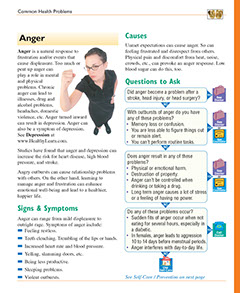
Anger is a natural response to frustration and/or events that cause displeasure. Too much or pent up anger can play a role in mental and physical problems. Chronic anger can lead to illnesses, drug and alcohol problems, headaches, domestic violence, etc. Anger turned inward can result in depression. Anger can also be a symptom of depression.
Studies have found that anger and depression can increase the risk for heart disease, high blood pressure, and stroke.
Angry outbursts can cause relationship problems with others. On the other hand, learning to manage anger and frustration can enhance emotional well-being and lead to a healthier, happier life.
Signs & Symptoms
Anger can range from mild displeasure to outright rage. Symptoms of anger include:
• Feeling restless.
• Teeth clenching. Trembling of the lips or hands.
• Increased heart rate and blood pressure.
• Yelling, slamming doors, etc.
• Being less productive.
• Sleeping problems.
• Violent outbursts.
Causes
Unmet expectations can cause anger. So can feeling frustrated and disrespect from others. Physical pain and discomfort from heat, noise, crowds, etc., can provoke an anger response. Low blood sugar can do this, too.
Treatment
Self-care measures can help in most cases. When these are not enough, an evaluation from a doctor or mental health care provider may be needed. Treatment will depend on the cause.
Questions to Ask
Question 1
Did anger become a problem after a stroke, head injury, or head surgery?
You should be seen by your doctor for medical advice. Contact your doctor or health care provider to find out how soon you should be seen.
Question 2
With outbursts of anger do you have any of these problems?
• Memory loss or confusion.
• You are less able to figure things out or remain alert.
• You can’t perform routine tasks.
You should be seen by your doctor or counselor. Contact your doctor, counselor or health care provider to find out how soon you should be seen.
Question 3
Does anger result in any of these problems?
• Physical or emotional harm.
• Destruction of property.
• Anger can’t be controlled when drinking or taking a drug.
• Long term anger causes a lot of stress or a feeling of having no power.
You should be seen by your doctor or counselor. Contact your doctor, counselor or health care provider to find out how soon you should be seen.
Question 4
Do any of these problems occur?
• Sudden fits of anger occur when not eating for several hours, especially in a diabetic.
• In females, anger leads to aggression 10 to 14 days before menstrual periods.
• Anger interferes with day-to-day life.
Call your doctor or health care provider and state the problem. He or she can decide what you should do.
Use Self-Care / Prevention:
You can probably take care of the problem yourself if you answered NO to all the questions. Use the “Self-Care” measures that are listed. Call your doctor if you don’t feel better soon, though. You may have some other problem.
Self-Care / Prevention
• Don’t ignore anger. Express it in a healthy way.
– Share your angry feelings with a person you trust and feel safe with, such as a friend, partner, teacher, etc.
– Get the anger “off your chest.” Do this calmly and without being cruel. Tell persons you feel angry with how they have upset you. You will likely start to feel better.
– If you can’t express your anger out loud, write it down.
• Express your wants, needs, and feelings, in ways that do not offend others. Doing so can keep you from feeling that you were taken advantage of and getting angry as a result. Use “I” rather than “you” statements. For example, say “I get angry when I feel put down by your comments in front of our friends.” Don’t say, “You make me angry when you put me down in front of our friends.”
• List reasons and times when you have too much anger. Note if there are any patterns to your anger and if they can be changed.
• Channel the energy from anger into something positive or creative. Clean out drawers. Take a short walk or do other exercises. Paint, write poems, etc.
• Distract yourself. If you’re stuck in traffic, try to accept the delay and that it is beyond your control. Instead of clenching the steering wheel, play pleasant music on the radio or listen to tapes or CDs that are calming.
• To lessen anger outbursts, think of what will happen as a result of your anger.
• Find humor in situations that result in anger.
• Practice learning to lighten up.
• Use stress management techniques on a routine basis.
• Think before you act or speak. Try to understand your anger. Plan how you want to react or respond.
• Eat healthy foods. Eat at regular times.
This website is not meant to substitute for expert medical advice or treatment. Follow your doctor’s or health care provider’s advice if it differs from what is given in this guide.
The American Institute for Preventive Medicine (AIPM) is not responsible for the availability or content of external sites, nor does AIPM endorse them. Also, it is the responsibility of the user to examine the copyright and licensing restrictions of external pages and to secure all necessary permission.
The content on this website is proprietary. You may not modify, copy, reproduce, republish, upload, post, transmit, or distribute, in any manner, the material on the website without the written permission of AIPM.
Pediatric Care
2022 © American Institute for Preventive Medicine - All Rights Reserved. Disclaimer | www.HealthyLife.com


